





Notebooks that are built to be written in
Hardcover and softcover, ruled, squared and dotted, in pocket, A5, A4 and square formats. Paper weights listed on every product, so you know before you buy whether your pen will go through the page.
A notebook is the simplest piece of equipment an artist, a student or a planner owns, and the one they touch most often. It is also the one people most often buy badly, because everything that makes a notebook good is invisible in a photograph. Art Shed stocks notebooks chosen on the things that actually matter day to day: paper heavy enough that your pen does not bleed through, a binding that behaves, a cover that holds its shape in a bag, and the small features that decide whether a book gets used or shelved. Australian owned, shipped Australia wide, and on the shelf at our Melbourne and Brisbane stores.
A notebook is the simplest piece of equipment an artist, a student or a planner owns, and the one they touch most often. It is also the one people most often buy badly, because everything that determines whether a notebook is good is invisible in a photograph. Two books that look identical on a shelf can behave completely differently the moment you put a pen to them.
This page is here to make that decision easy. Below you will find what each page layout is actually for, how to pick a size you will carry, the difference hardcover and softcover really makes, and what paper weight means in practice, which is the number that decides whether your pen bleeds through. Then the ranges we stock, and answers to the questions we get asked across the counter every week.
What to look for in a notebook
Eight things separate a notebook you finish from one that ends up in a drawer. Every product page in this category lists these, so you can compare like with like.
Page layout
Ruled, squared or dotted. This is the decision that most changes how the book feels to use, and it is worth a moment rather than defaulting to lined out of habit.
Size
Pocket, everyday carry, full page or square. Buy the size you will actually carry, because the best notebook is the one you have on you.
Cover
Hardcover for protection and a writing surface you can use on your knee. Softcover for weight and flexibility. Neither is better, they solve different problems.
Paper weight
Measured in GSM. This decides whether your pen bleeds through. Heavier paper means fewer pages for the same thickness, so it is a trade rather than a straight upgrade.
Binding
Stitch bound books open flat, which matters if you write across the gutter or draw spreads. Glued and spiral bindings behave differently and suit different work.
Page count
Not just how long it lasts. A thick book is a commitment, a thin one is easier to finish, and finishing a notebook is its own kind of motivation.
Paper colour
White gives maximum contrast and scans cleanly. Cream or ivory is softer under long use and flatters warm inks and coloured pencil.
The extras
Elastic closure, ribbon marker, inner pocket, pen loop, perforated pages, index and numbered pages. Small features, but they decide whether a book gets used or shelved.
Ruled, squared or dotted: choosing your page layout
Ruled pages carry horizontal lines, commonly between 6mm and 8mm apart. This is the classic writing notebook: lecture notes, meeting minutes, diary entries, drafting, correspondence and anything where you want your handwriting to sit straight without thinking about it. Check the line spacing if you have particularly large or small handwriting, since the difference between 6mm and 8mm is significant over a page.
Squared pages use a printed grid, usually 5mm. A grid earns its keep the moment your content has structure: maths and science working, budgets and tables, floor plans, technical drawing, layout roughs, knitting and cross stitch charts, and study notes that want columns. It also makes an excellent general purpose page for anyone who writes and sketches in the same book, because the lines guide both.
Dotted pages place a small faint dot at each grid intersection and nothing else. You get all the alignment help of a grid with a page that still reads as blank, which is why dot grid has become the default for bullet journalling, hand lettering, sketching, mind mapping and any layout you want to design yourself. If you are only buying one notebook and you are not sure what you will use it for, dotted is the most flexible of the three.
Quick rule of thumb. Writing in sentences, buy ruled. Working with numbers, structure or technical content, buy squared. Designing your own pages, journalling or drawing, buy dotted.
Notebook sizes explained
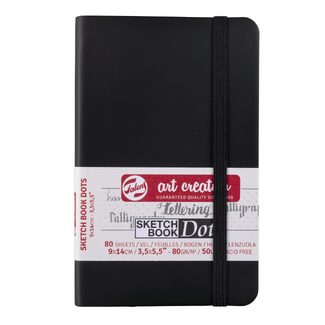
Pocket and A6, around 9x14cm. This is a capture book: the one that lives in a jacket, a handbag or a backpack side pocket for ideas, lists, phone numbers and quick thumbnail sketches. Small enough that you will actually have it on you, which is the entire point of a pocket notebook.
A5, around 13x21cm. The all rounder, and the size most people picture when they say notebook. Big enough to write and draw properly, small enough to carry every day, and the standard format for bullet journalling, so nearly every spread, template and tutorial online is designed around it. If you are buying one notebook, buy this one.
A4, around 21x30cm. Full page working size. University and TAFE notes, project planning, client work, larger drawings, and anything you want to be able to read across a desk. A4 is also the format that scans and photocopies without reduction, which matters if your notes get shared.
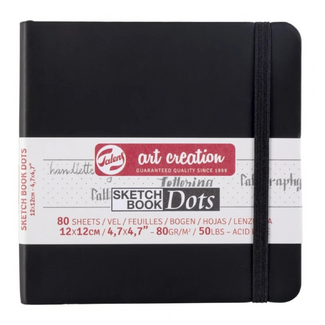
Square formats, such as 20x20cm. A deliberate choice rather than a compromise. A square page has no default orientation, which changes how you compose on it: spreads sit differently, sketches are not pushed into portrait or landscape, and layouts get room on both axes. Illustrators, designers and journallers who find the A5 rectangle limiting tend to prefer it.
Hardcover or softcover
This is the choice people agonise over and it comes down to one question: where does the book live?
Hardcover means a rigid board under the cover paper. It protects the block, keeps the corners from curling, and gives you a writing surface you can use on your knee, standing up, or on a train. A hardcover book will still be square at the end of a year in a backpack. The cost is weight and thickness, and a book that does not roll or flex.
Softcover means a flexible cover, usually a heavy card or a coated stock. It is lighter, slimmer and more forgiving in a crowded bag, it will bend into a jacket pocket, and it is the better choice if you carry several books at once or work mostly at a desk where you do not need the cover as a writing surface. The cost is protection: corners soften and the cover marks over time.
There is no better option here, only a better fit. If the book leaves the house every day and gets written in standing up, buy hardcover. If it sits on a desk or rides in a bag alongside three other things, softcover is lighter and does the job.
Paper weight explained: what GSM actually means
GSM stands for grams per square metre and it is the standard measure of paper weight. It is the single most useful number on a notebook listing, because it predicts whether your pen will bleed through, whether the page will buckle when you press, and how the book feels under the nib. Every notebook in this category lists its paper weight.
70 to 90gsm
Standard notebook and copy paper
Fine for pencil and ballpoint. Fineliner and gel ink will usually ghost on the reverse and fountain pen will often bleed. This is what most inexpensive notebooks use.
100 to 120gsm
Better writing paper
The point at which most pens stop showing through. A good choice if you write in fountain pen or gel ink but want a book that is still slim and light to carry.
140 to 160gsm
Heavy writing and light drawing
Bleed resistant with most pens, takes pencil, brush pen and light ink work, and does not buckle when you press. Roughly twice the weight of copy paper.
170gsm and above
Drawing and mixed media
Sketchbook and pad territory rather than notebook. Built to take washes, markers and heavier wet media without cockling.
One thing worth knowing before you chase the highest number you can find: heavier paper means fewer pages in the same thickness of book. A 100gsm notebook and a 160gsm notebook of the same physical size will not hold the same number of sheets. Choose the weight around the pen you actually use, not around the idea that more is better.
What you can write and draw in them
- Ballpoint, rollerball and gel pen. Comfortable on almost any notebook paper. If you use gel and fineliner pens, anything from 100gsm up will hold them cleanly.
- Fountain pen. Look for 100gsm or more, and for paper described as bleed resistant. Very wet nibs and heavily saturated inks may still ghost on the reverse, which is true of almost any notebook.
- Fineliner and technical pen. Excellent across the range. Pigment fineliners are exactly what most notebook stock is designed around.
- Pencil and coloured pencil. The slight tooth of most notebook paper holds graphite and coloured pencil well, and erases cleanly.
- Brush pen and hand lettering. Choose 120gsm or above, and a dot grid for the easiest guide there is to keeping letterforms consistent.
- Alcohol markers and wet media. Heavy alcohol markers and inks will go through notebook paper at any weight. For sustained wet work, use a sketchpad or a watercolour pad built for the load.
The ranges we stock
We stock notebooks we would use ourselves, and we carry the specifications on every product page so you can compare them properly rather than guessing from a photograph.
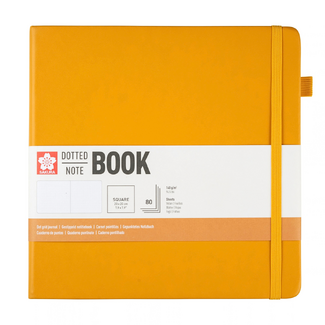
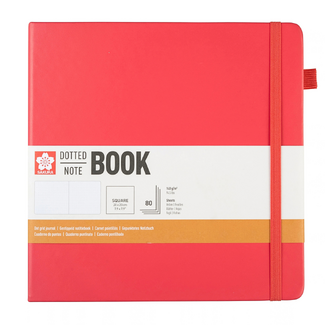
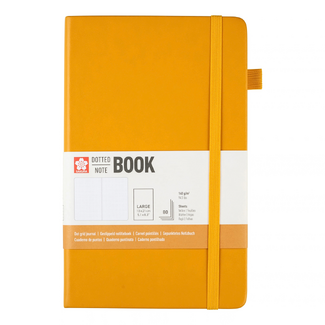
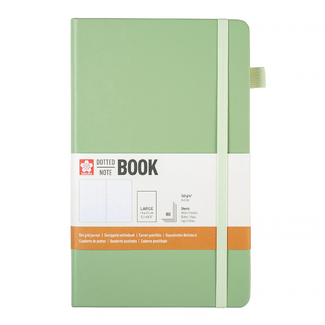
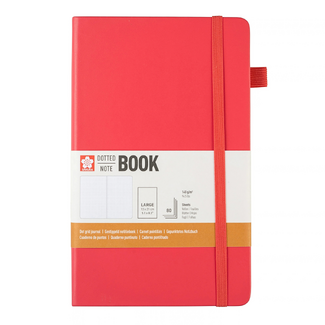
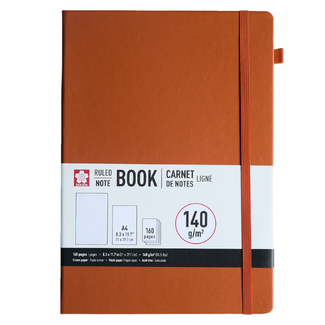
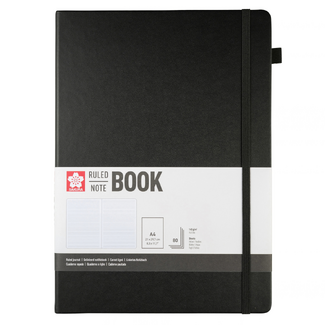
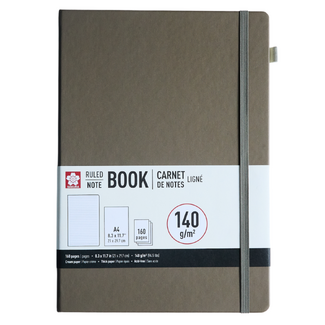
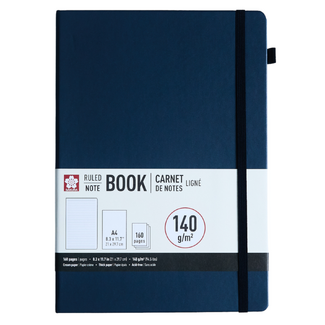
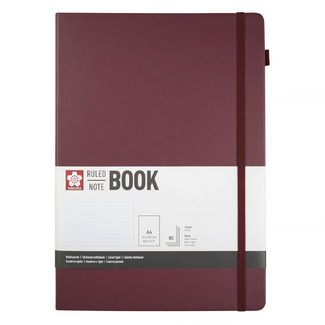
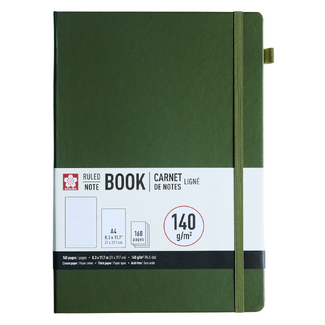
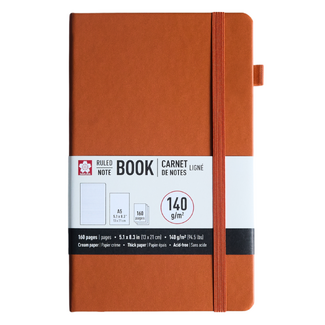
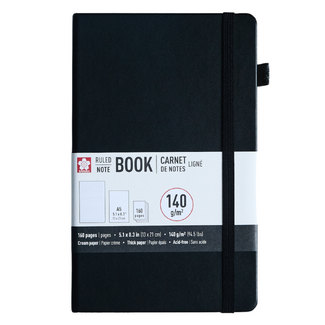
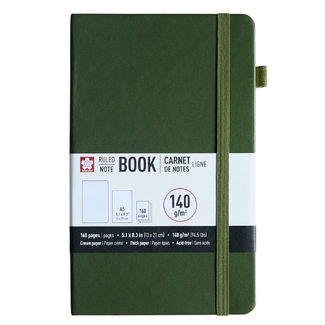
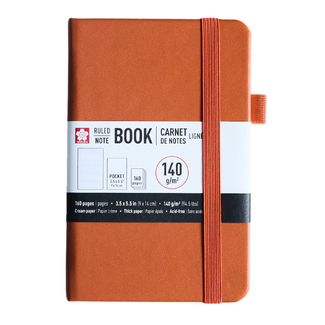
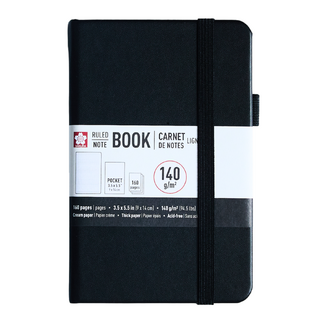
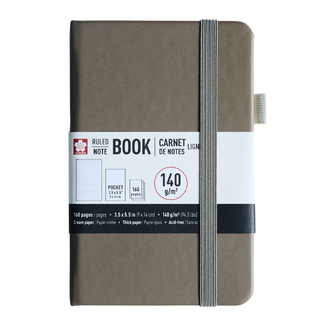
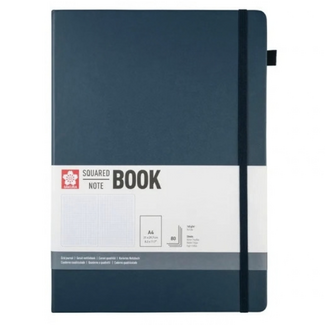
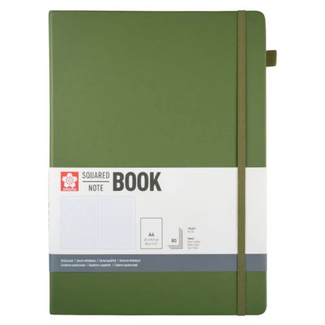
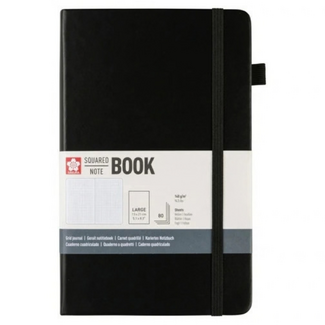
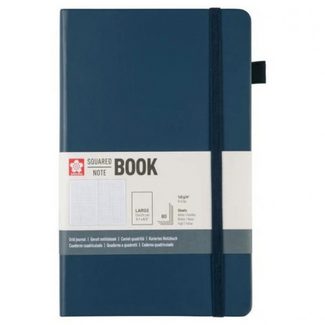
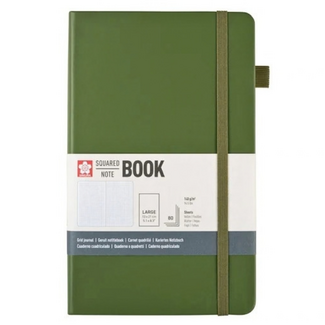
Sakura hardcover notebooks
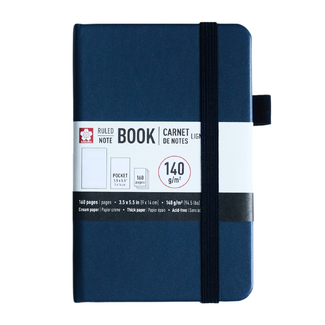
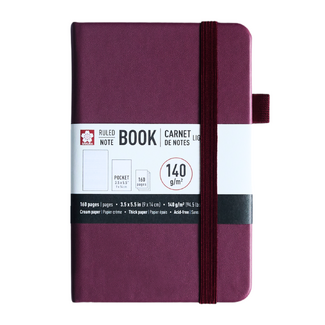
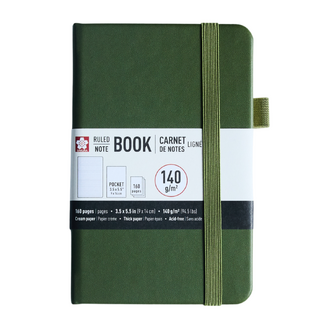
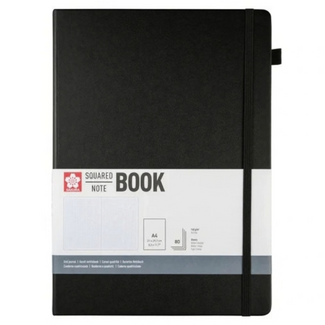
From the Japanese company behind Pigma Micron fineliners, Gelly Roll gel pens and Koi watercolours. A heavier, more considered book than a standard notebook, built around thick paper and a binding that opens flat.
- Hardcover with rounded corners
- 140gsm acid free, bleed resistant paper in a soft cream tone
- 160 pages, stitch bound so it lays completely flat
- Elastic closure, satin ribbon marker, pen loop and expandable inner pocket
- FSC certified paper
- Ruled at 7mm, squared at 5mm and dotted at 5mm
- A6 9x14cm, A5 13x21cm, A4 21x30cm and a 20x20cm square
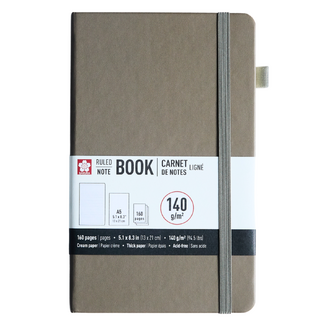
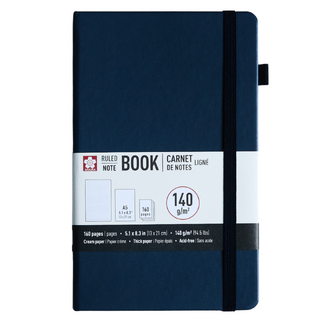
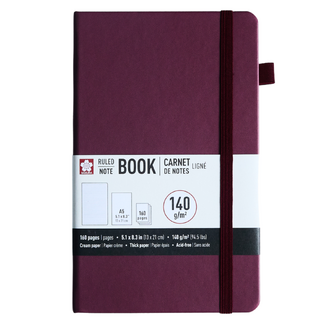
- Nine colourways: Amber, Mulberry, Deep Indigo, Pine Needle, Cinder, Black, Plum Blossom, Japanese Kerria and Pale Patina
Who these notebooks are for
Students. A hardcover book survives a year in a backpack in a way a stapled pad does not, and acid free paper means the notes are still legible when you need them for an exam, a folio or a reference years later. A4 ruled for lectures, A5 for tutorials and reading notes.
Bullet journallers and planners. A5 dotted, undated, so you start on any day of any year with no wasted pages. A binding that lays flat is not a luxury here: it is what lets you rule a spread across the gutter without the book fighting you.
Artists and illustrators. A pocket notebook for thumbnails and idea capture, and a larger dotted or square book for developing work. Pair one with a portfolio when the work leaves the studio.
Writers, professionals and anyone in meetings. Ruled A5 or A4, a pen in the loop, a ribbon on today's page and an elastic band holding the whole thing shut. A notebook that opens to the right page and does not shed paper is a notebook you keep using.
Gifts. A notebook is one of the few gifts that is genuinely useful to almost everyone. Pair one with a set of pens or a brush pen for a complete present.
Buying notebooks online in Australia
Art Shed is an Australian owned art supplies retailer. We ship notebooks Australia wide from our own warehouses, and you can also buy the range over the counter at our Melbourne store at 475 Warrigal Road, Moorabbin, or at our Brisbane store in West End. Orders placed before 11am AEST on a business day are dispatched the same day outside sale periods, every order is tracked, and Click and Collect from Moorabbin is generally ready within 1 to 3 business days. We ship to New Zealand as well.
Express Post generally runs 1 to 2 business days to metropolitan Victoria, New South Wales, Queensland, South Australia, the ACT and Tasmania, and 2 to 3 business days to Western Australia, the Northern Territory and regional areas. Standard Post generally runs 2 to 5 business days and 6 to 8 business days respectively.
If you are building out a wider paper kit, the rest of our art pads and paper range sits alongside this one, including sketchpads, visual diaries, watercolour pads and bristol board, and the full drawing range covers the pens, pencils and markers to fill them.
Frequently Asked Questions
What is the difference between ruled, squared and dotted notebooks?
Ruled pages carry horizontal lines and suit continuous writing: lectures, meetings, diaries and drafting. Squared pages use a printed grid, usually 5mm, and suit anything with structure, such as maths, plans, tables, layouts and technical notes. Dotted pages place a small faint dot at each grid intersection and nothing else, which gives the same alignment help as a grid while leaving the page looking almost blank. Dotted is the usual choice for bullet journalling, sketching and hand lettering, and it is the most flexible of the three if you are only buying one.
Should I buy a hardcover or a softcover notebook?
Buy hardcover if the book lives in a bag, gets used away from a desk, or needs to last a year or more. The rigid cover protects the pages and gives you a writing surface you can use on your knee or standing up. Buy softcover if weight and bulk matter, if you carry several books at once, or if you like a book that flexes and rolls into a pocket. Softcovers are lighter and slimmer for the same page count. Neither is better in the abstract, they solve different problems.
What GSM should I look for in a notebook?
GSM is grams per square metre, the standard measure of paper weight, and it is the single number that predicts whether your pen bleeds through. Copy paper is around 80gsm and most inexpensive notebooks sit between 70gsm and 100gsm, which is fine for pencil and ballpoint but will often ghost under gel ink and bleed under fountain pen. From 100gsm to 120gsm most pens stop showing through. From 140gsm the paper is bleed resistant with nearly everything short of heavy markers, and takes light drawing as well. Above 170gsm you are into sketchbook territory. Heavier paper means fewer pages for the same thickness, so it is a trade rather than a straight upgrade.
What size notebook should I buy?
A6 at roughly 9x14cm fits a pocket or a small bag and works as a carry-everywhere capture book. A5 at roughly 13x21cm is the all rounder and the size most people mean when they say notebook: large enough to write and sketch in, small enough to carry daily. A4 at roughly 21x30cm gives you full page room for lecture notes, project planning and larger drawings, and scans without reduction. Square formats such as 20x20cm have no default orientation, which changes how you compose on the page and suits spreads and sketchbook style work.
Which notebook is best for bullet journalling?
A5 dotted is the standard bullet journal format and the one nearly every template, spread and online tutorial assumes. The dot grid gives you alignment for trackers, calendars and tables without ruled lines showing through your layout, and A5 is portable enough to carry daily. Look for a book that lays flat, since you will be ruling spreads across the gutter, and for paper at 100gsm or above if you use brush pens or markers.
Why does it matter whether a notebook lays flat?
A stitch bound book opens completely flat because the pages are sewn into sections rather than glued to the spine. That matters if you write across the gutter, draw double page spreads, or need the book to stay open on a desk without being held down. A glued block will fight you and eventually crack at the spine if you force it. Spiral binding also lays flat and folds back on itself, at the cost of a coil that catches in a bag.
Can you draw in a notebook?
Yes, within limits set by the paper. At 140gsm and above, notebook paper takes graphite, coloured pencil, fineliner, brush pen and light ink comfortably. Below about 100gsm you will get show through with anything wetter than a pencil. Dotted and squared layouts are the easiest to draw on because the guide marks are unobtrusive. For sustained wet work such as watercolour, ink washes or heavy alcohol markers, use a sketchpad or watercolour pad built for the load rather than a notebook.
Is white or cream paper better?
It is a preference, not a quality difference. White gives maximum contrast, photographs and scans cleanly, and makes colour work read accurately. Cream or ivory reduces glare, which many people find easier over long writing sessions, and it flatters warm inks, sepia and coloured pencil. If your notes get scanned or shared as images, lean white. If you write for hours, try cream.
What does acid free mean and does it matter?
Acid free paper has had the acidic compounds removed or neutralised during manufacture. Acid is what makes ordinary paper yellow, grow brittle and crumble at the edges over years. If a notebook holds anything you want to keep, a journal, a sketchbook, project records, research notes, acid free paper is what keeps it readable and intact for decades rather than discolouring.
What does FSC certified mean?
FSC stands for Forest Stewardship Council. An FSC certified paper has a documented chain of custody back to forests managed to the FSC standard for environmental, social and economic responsibility. It is the most widely recognised certification of its kind and the simplest way to tell that the fibre in a notebook has been sourced responsibly.
Are these notebooks good for fountain pens?
It depends on the paper weight, which is listed on every product page. At 140gsm and above, bleed resistant stock handles most nibs cleanly, with ink sitting on the surface rather than soaking through. Very wet nibs and heavily saturated inks may still ghost on the reverse, which is true of almost any notebook paper. Below 100gsm, expect bleed through with most fountain pens.
What is the difference between a notebook, a visual diary and a sketchpad?
A notebook is bound for writing, usually with a printed layout, a cover meant to survive carrying, and paper chosen around ink. A visual diary is a bound book of blank drawing paper, often with a dated or undated planner structure, built for sketching rather than writing. A sketchpad is a pad of loose or gummed drawing sheets you can tear out, with heavier paper and no expectation the book stays intact. If you are writing, buy a notebook. If you are drawing and want to keep the work bound, buy a visual diary. If you want to tear pages out, buy a sketchpad.
Can I use a notebook as a diary or planner?
Yes, and an undated notebook has an advantage over a printed planner: you rule up your own weeks and months, start whenever you like, and waste nothing if you begin mid year or skip a fortnight. A slower week costs you no pages. If you would rather have the dates printed for you, look at our visual diaries and dated planners.
Do you sell notebooks in bulk for schools, studios or offices?
Yes. Art Shed supplies schools, universities, studios, offices and community groups across Australia, and hardcover notebooks are a common choice for class sets and staff issue because they survive a year of use. Contact us with what you need and we will quote it.
Where can I buy notebooks in Australia?
Art Shed stocks the range online and ships Australia wide from our own warehouses, and you can also buy over the counter at our Melbourne store at 475 Warrigal Road, Moorabbin, or our Brisbane store in West End. Art Shed is an Australian owned art supplies retailer. We also ship to New Zealand.
How fast will my notebook arrive?
Orders placed before 11am AEST on a business day are dispatched the same day outside sale periods. Express Post is generally 1 to 2 business days to metropolitan Victoria, New South Wales, Queensland, South Australia, the ACT and Tasmania, and 2 to 3 business days to Western Australia, the Northern Territory and regional areas. Standard Post is generally 2 to 5 business days and 6 to 8 business days respectively. Every order is tracked.
Can I collect my order instead of having it posted?
Yes. Click and Collect is available from our Moorabbin store at 475 Warrigal Road in Melbourne and is generally ready within 1 to 3 business days. You will get a notification when your order is packed and waiting.
Need help choosing? Our team works with these materials every day. Call us, email us or come into the Moorabbin or West End store and we will talk you through the difference between the layouts, covers and paper weights before you buy.