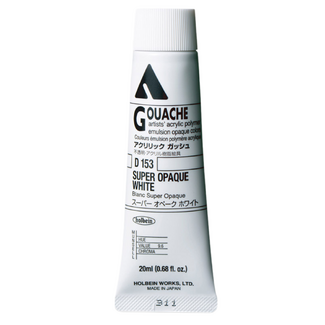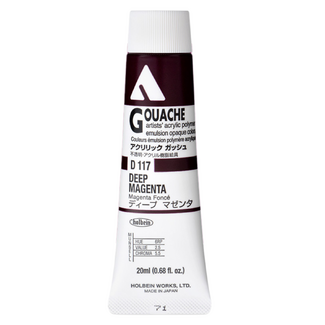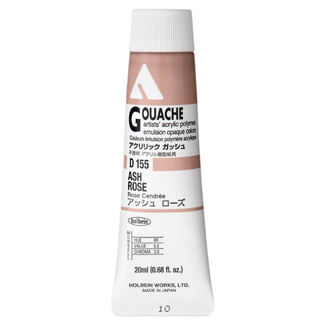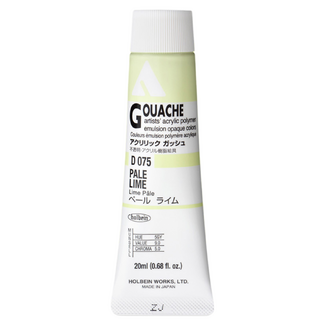


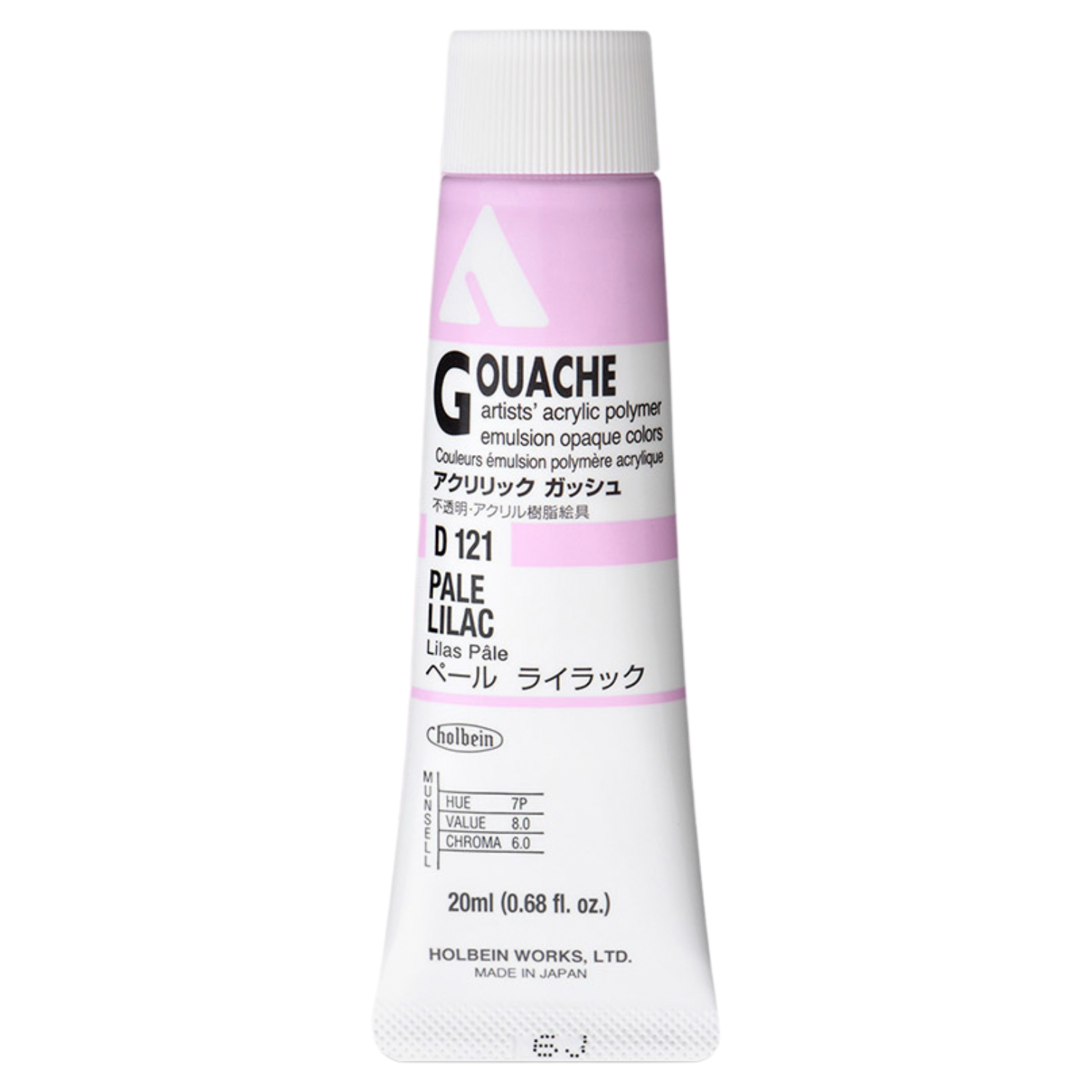
Holbein Acrylic Gouache #121 Pale Lilac 20ml
Our everyday low price
or 4 interest-free installments of $2.74 with

Own it now, pay later

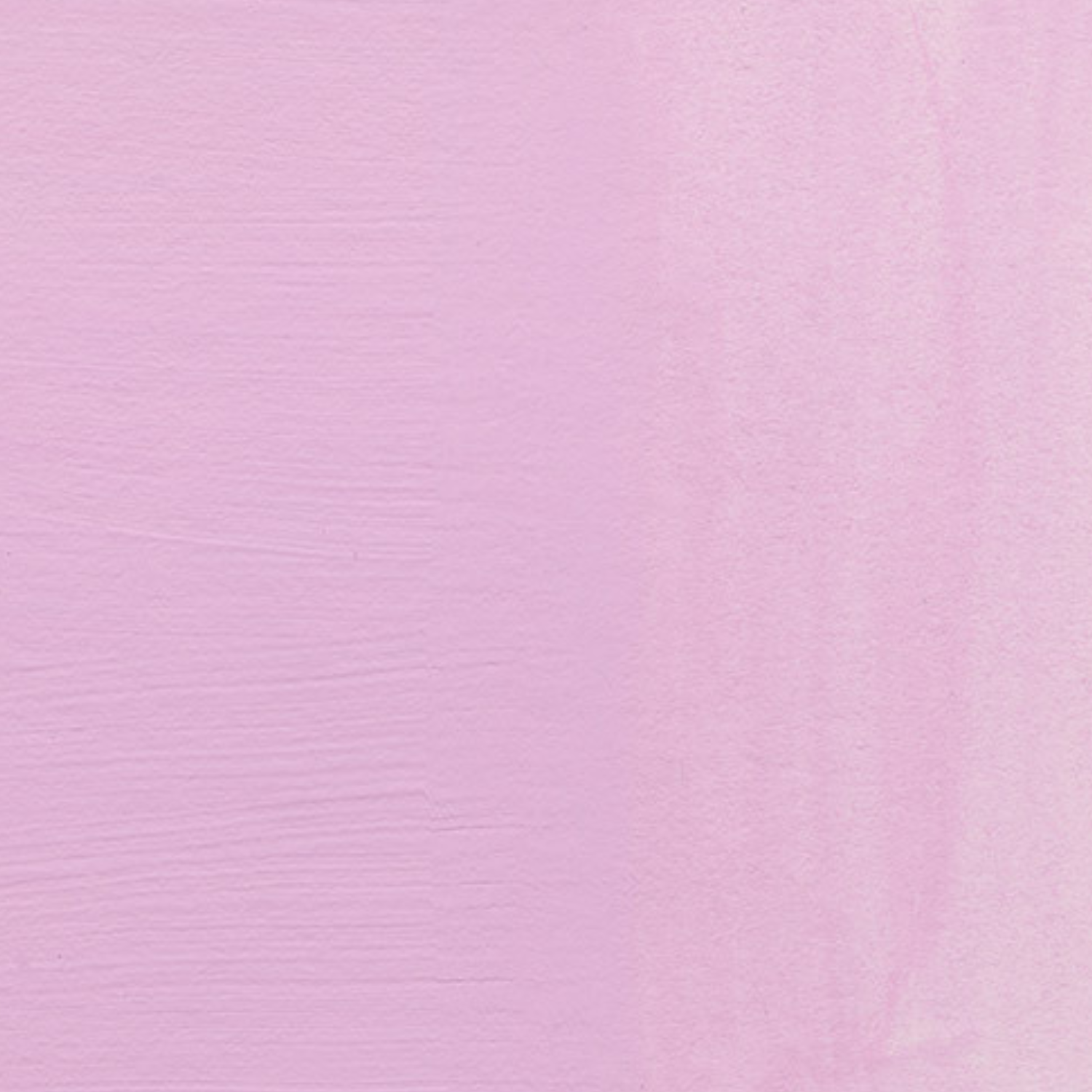
Pale Lilac combines PR122 Quinacridone Pigment with PV23 Dioxazine and PW6 Titanium Dioxide. The white is the dominant partner here. Munsell reads 7.0P 8.0/6.0, giving a very light value of 8.0 and a low chroma of 6.0 at a hue that sits squarely in purple. On paper it is a delicate powdery pink-lilac, the gentlest colour in this part of the range. Two stars for lightfastness.
This is petal colour, and it is also excellent for the things people forget need a pale violet: cool highlights on dark skin, the sheen on a black feather, the faded side of a pink wall, sugar icing, tulle. Illustrators lean on very pale tints as breathing space between saturated shapes, which is hard to do with white alone. It lays down as an even light field, takes pencil and ink cleanly once dry, and Rose Violet steps it back up to full strength when you want the saturated end of the same hue.
What Makes This Colour Special
Pigment, lightfastness and series as published by Holbein. Holbein does not publish an opacity rating for individual colours; the range as a whole is described by Holbein as opaque.
Acrylic Gouache, Not Traditional Gouache
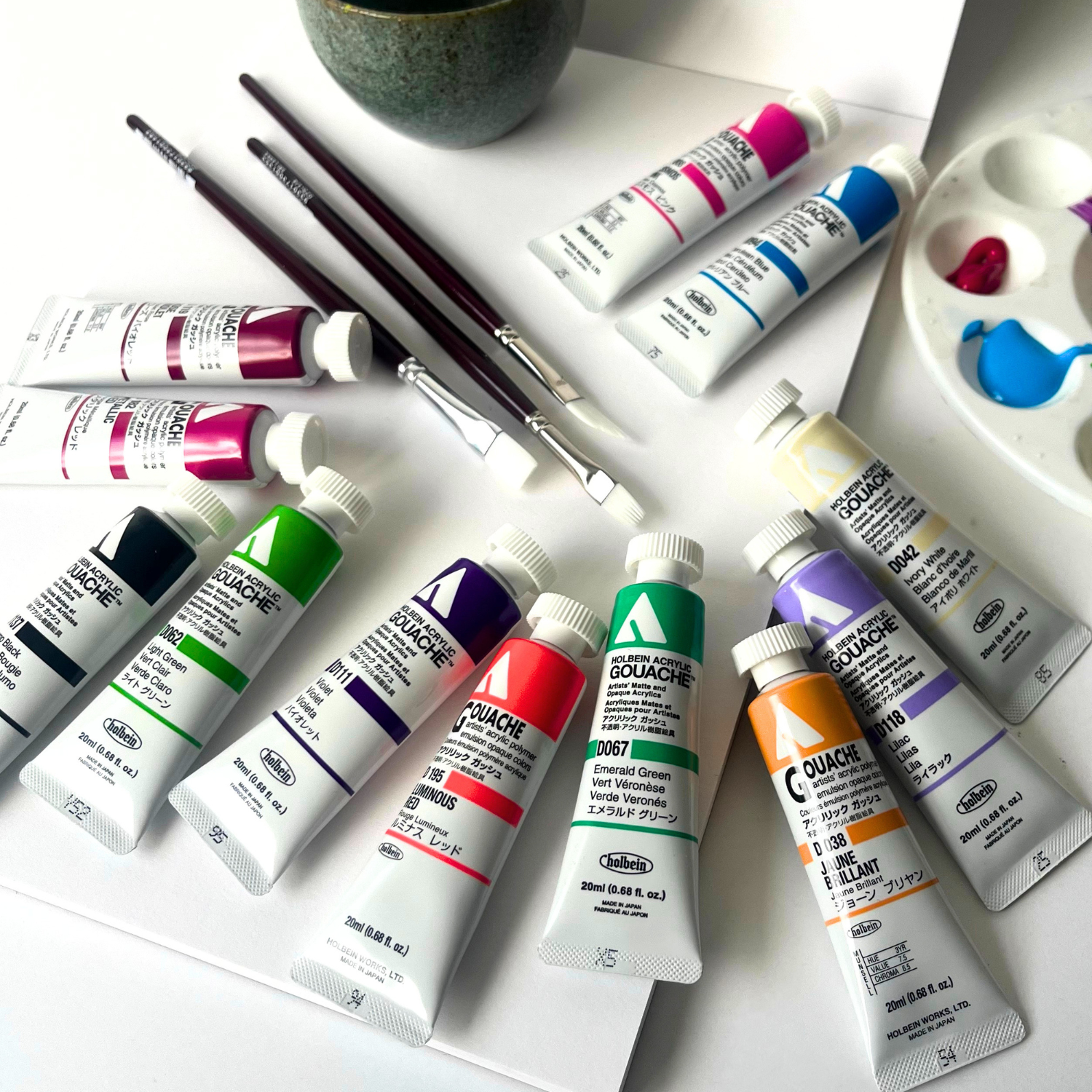
Holbein describes this simply as an opaque acrylic paint, and that covers it. Finely ground pigment in an acrylic emulsion, thinned with water, laid down flat. Holbein Acrylic Gouache dries to a matte opaque finish and is water resistant once dry, so it does not reactivate with water like traditional gouache. That is precisely why a pale colour like Pale Lilac works as a highlight over darker passages: nothing underneath comes up into it. See the rest of the brand on our Holbein page.
Why Holbein Acrylic Gouache Is in Serious Studios
- Genuinely opaque. Holbein describes the range simply as an opaque acrylic paint. It covers, including over darker colour, which is the whole point of reaching for gouache rather than watercolour.
- Velvety matte, no sheen. Holbein describes the colour as opaque, intense, smooth and velvety. It dries flat, which is why it photographs and scans without glare.
- Water resistant once dry, so you can layer. Holbein’s own wording, and the reason the range exists. A dry layer will take another one over the top without lifting.
- The colour you mix is the colour you get. Holbein states it does not shift in colour tone from wet to dried colour. Anyone who has watched a perfect grey dry into a different grey will appreciate that.
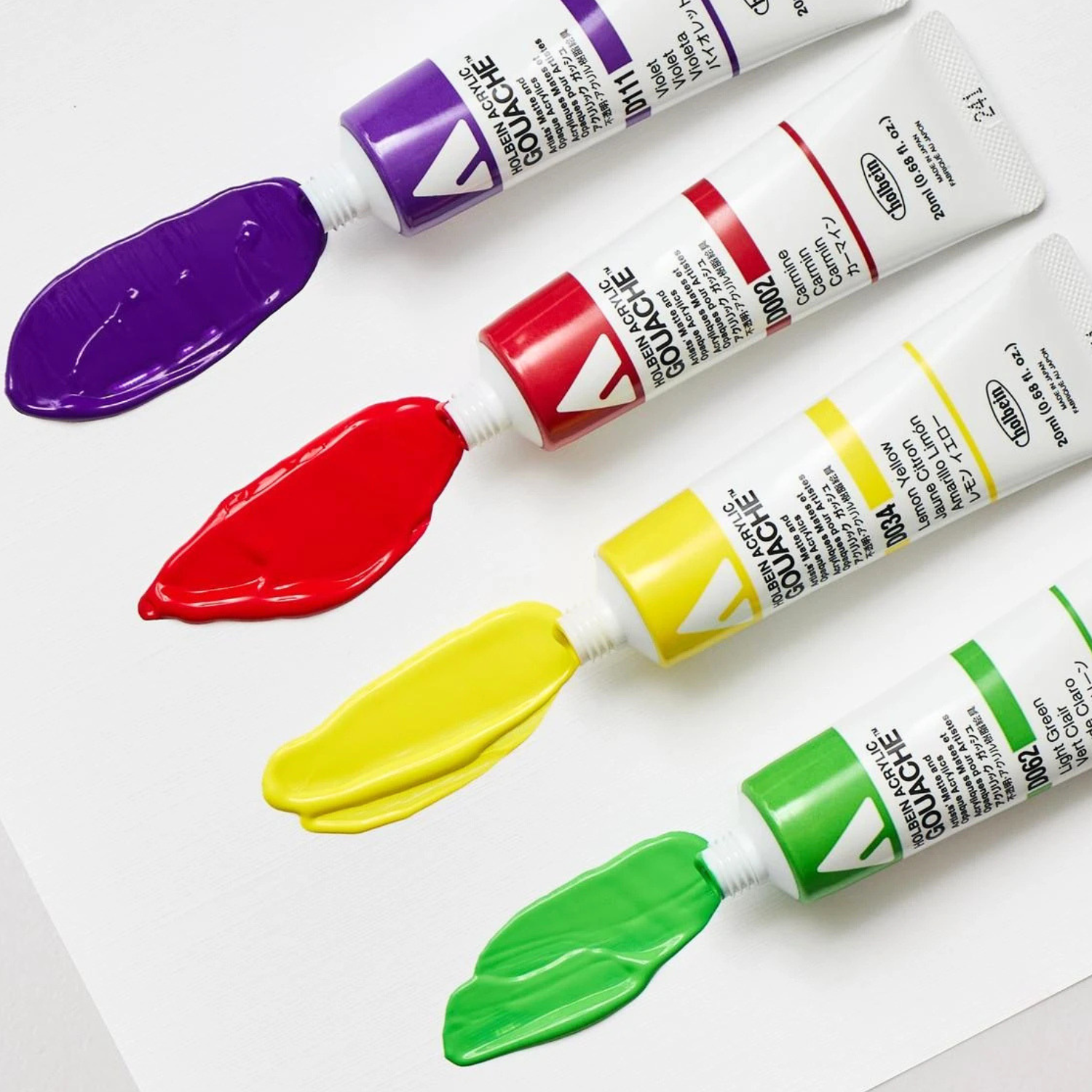
- Built to use straight from the tube. Holbein says it is specifically designed to be used directly from the tube and will dry to even, uniform paint layers.
- Works on more than paper. Holbein lists paper, canvas, cloth, stone, wood, leather, plexiglass and concrete, with excellent adhesion, and full compatibility with all acrylic mediums.
Getting the Most Out of This Tube
Straight from the tube is the default. This is what Holbein designed it for, and it is where you get those even, flat, uniform layers. Add a little water to loosen it, but go easy: very diluted washes can dry streaky across a large flat area, so build coverage in thin even coats rather than flooding it on.
Watch the palette, not the clock. Holbein gives an open time of roughly 10 to 30 minutes and notes the drying time is much like ordinary watercolour. The practical consequence is that paint left sitting on the palette will go off and will not come back, so squeeze out small amounts as you need them.
It plays well with acrylic mediums. Holbein states the range is compatible with all acrylic mediums, so you can change the body or extend the working time if you want to. Soft synthetic brushes suit it, since they hold enough paint to lay a flat area without dragging.
Questions About Holbein Pale Lilac
How is this different from Lilac?
Mostly by how light it is and which way it leans. Lilac is PV23 and white at value 6.5 and hue 9.0PB, so it is a mid-tone with a blue bias. Pale Lilac adds PR122 quinacridone, which swings the hue to 7.0P, and sits much lighter at value 8.0. In short, Lilac is the cool one, this is the pink-leaning pale one.
Can I use it as a highlight over darker colours?
Yes, and it is one of the nicer ways to use it. Let the underlying passage dry properly first, because acrylic gouache is water resistant once cured and that is what lets you work light over dark without pulling the base up. Keep the highlight brush fairly dry so the mark stays crisp.
Does Holbein Acrylic Gouache reactivate with water once dry?
No. Holbein describes it as water resistant once dry, specifically so you can paint layer upon layer, which is the main practical difference from traditional gum arabic gouache. Note that Holbein says water resistant rather than waterproof, and very thin, heavily diluted passages can still be disturbed if you scrub at them with a wet brush.

(NU2540021121)
| Information PDF | Download PDF |
| SKU | NU2540021121 |
| Barcode # | 4900669071211 |
| Brand | Holbein |
| Shipping Weight | 0.0290kg |
| Shipping Width | 0.035m |
| Shipping Height | 0.020m |
| Shipping Length | 0.100m |
More From This Category