

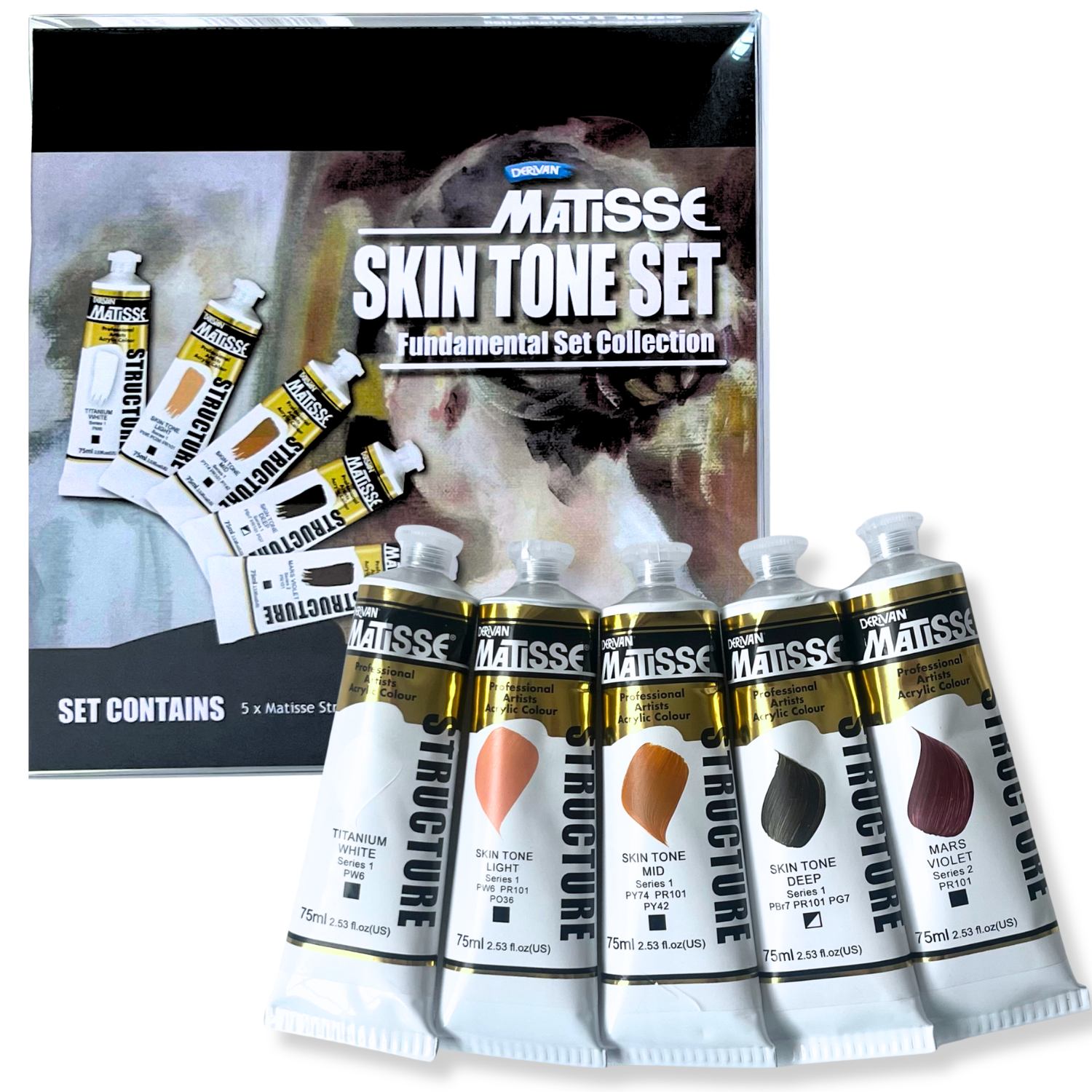
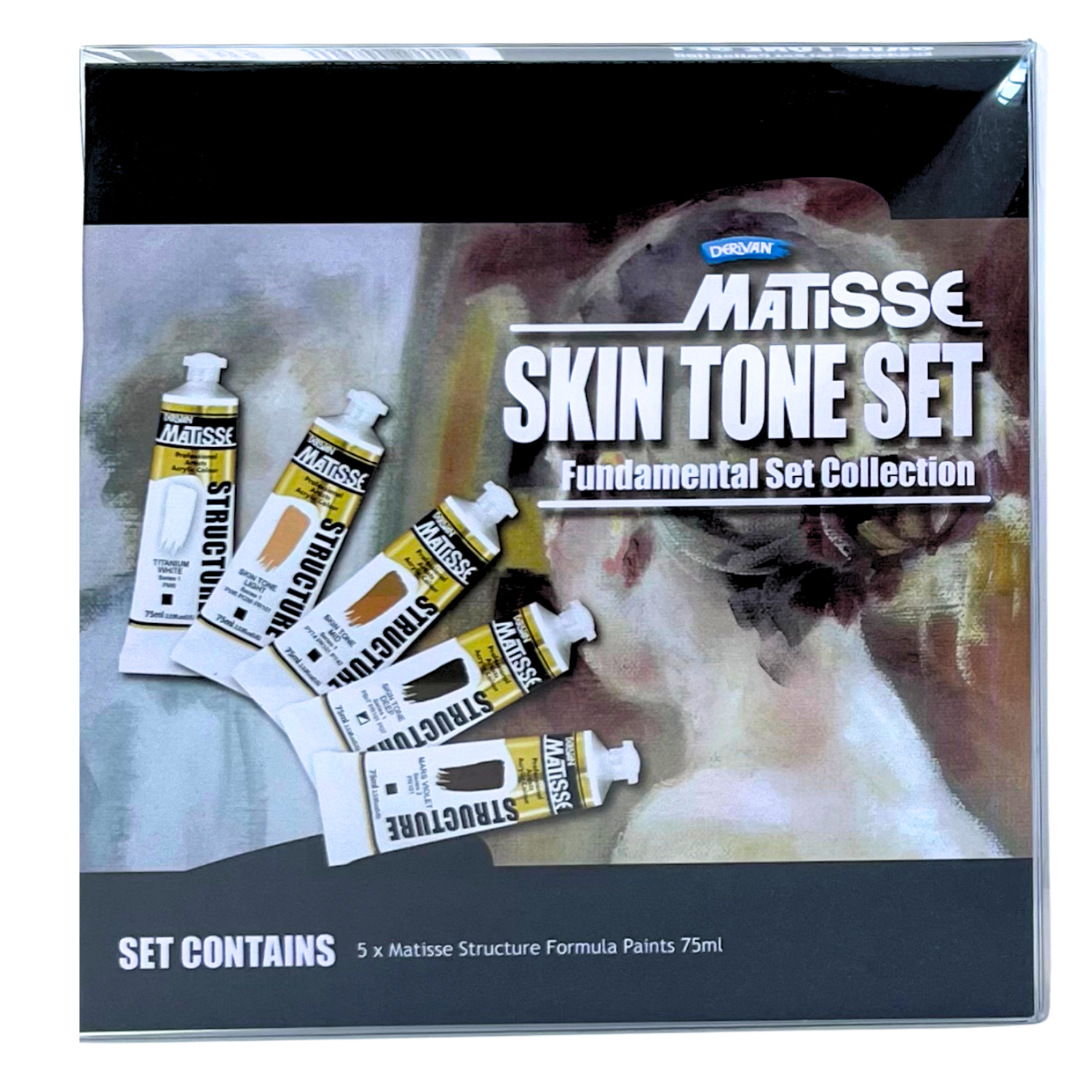
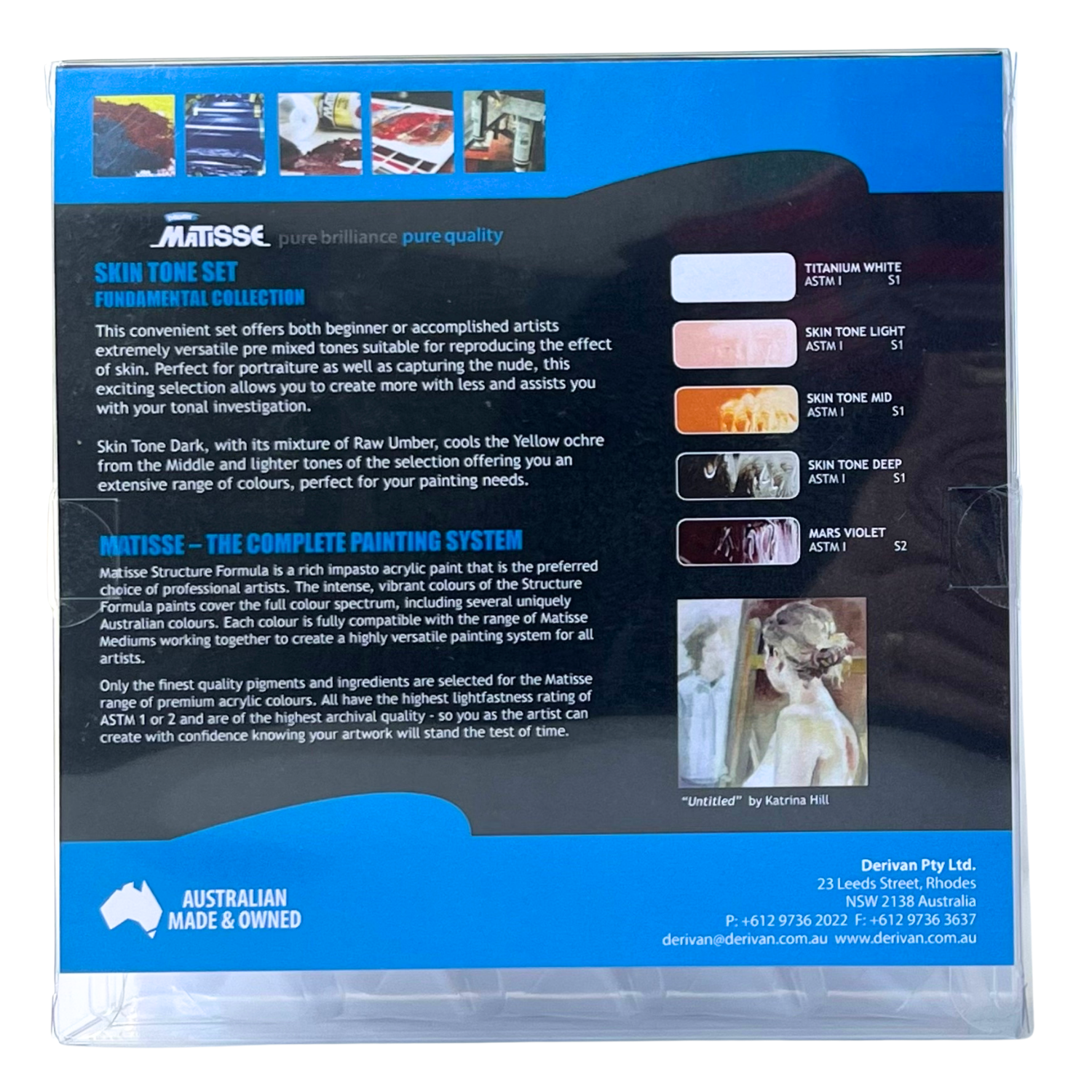
Matisse Structure Skin Tone Fundamental Set 5x75ml
Our everyday low price
or 4 interest-free installments of $16.24 with

Own it now, pay later

Matisse Structure Skin Tone Fundamental Set 5x75ml
Portrait painting demands a different kind of thinking about colour. Unlike landscape or abstraction, where the colour temperature of a mix can drift a degree or two without consequence, figurative work is unforgiving. Human skin contains iron, and so does the best palette for rendering it. The five colours in the Matisse Structure Skin Tone Fundamental Set are built around iron oxide pigments, the same class of materials that has anchored figurative painting since the Renaissance, formulated into the opaque, heavy-body consistency of Matisse Structure Formula acrylic. From the warm opacity of Skin Tone Light to the sophisticated darkness of Skin Tone Deep, and with Mars Violet as the cool shadow tone that replaces the deadening effect of lamp black, this is a considered, professional-grade portrait palette in a single box.
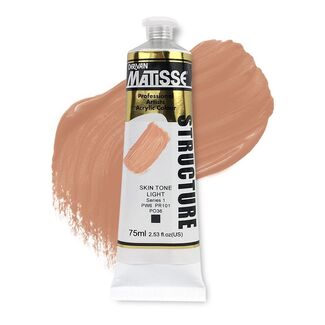
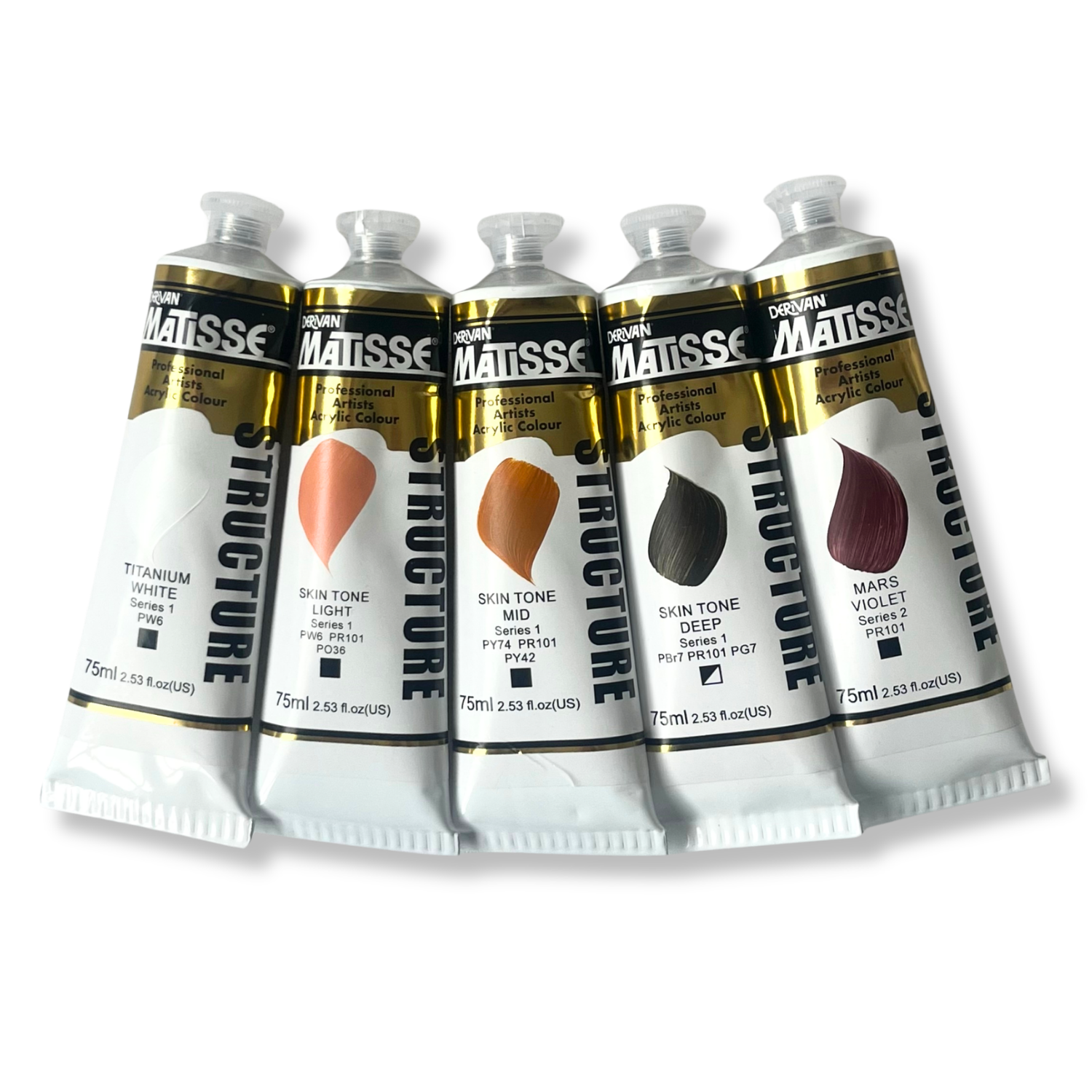
Each colour in the set addresses a specific problem. Titanium White is the lightest point of the value scale and the base for mixing highlights. Skin Tone Light is a pre-formulated warm peach built from titanium white, benzimidazolone orange, and red iron oxide, giving an opaque, consistent base suitable for fair to medium complexions under warm light. Skin Tone Mid contains no white at all: its combination of Hansa Yellow, Yellow Iron Oxide, and Red Iron Oxide produces a translucent, warm ochre-flesh that sits in the middle of the tonal range and carries the hue through transitional passages. Skin Tone Deep brings Phthalo Green together with Raw Umber and Red Iron Oxide, a combination that creates a deep, rich, neutral-dark tone without the chalky deadness of black. Mars Violet, a single-pigment dull reddish-purple iron oxide, anchors the shadow end of the palette, cooling and neutralising mixes in the way that observed shadow colour in flesh actually behaves under ambient light.
| Colour | Series | Pigments / Notes |
|---|---|---|
| Titanium White | S1 | PW6 · Opaque, bright white · ASTM I · highlights, tinting, and lightening |
| Skin Tone Light | S1 | PW6 + PO36 + PR101 · Warm peach-apricot · opaque · fair to medium complexions under warm light |
| Skin Tone Mid | S1 | PY74 + PY42 + PR101 · Warm ochre-flesh · no white · luminous mid-tones and transitional passages |
| Skin Tone Deep | S1 | PG7 + PBr7 + PR101 · Rich warm-neutral dark · ASTM I · deep complexions, dark shadows without using black |
| Mars Violet | S2 | PR101 · Dull bluish-purple iron oxide · ASTM I · cool shadow passages, violet undertones in dark flesh |
The reason portrait painters struggle with acrylics is rarely the paint. It is the palette. Most general-purpose colour assortments are built around saturated hues designed for maximum versatility across subjects and styles. A portrait palette needs something quite different: pre-mixed tones in the earthy, muted range of human skin, pigments that don't shift their character violently when mixed together, and a shadow colour that respects the warm-cool optical complexity of how shadows read in flesh. Derivan's formulation of the Skin Tone range achieves all three. The iron oxide backbone of every colour in the set means that transitions between tones are smooth, predictable, and free from the muddiness that occurs when warm and cool synthetic pigments of very different tinting strengths collide on the palette.
Mix a small amount of Titanium White into Skin Tone Light to achieve your lightest values, the passages where light strikes the highest planes of the face: forehead, nose bridge, cheekbone. The resulting tint retains the warm peachy character of the Skin Tone Light without going chalky. Reserve pure Titanium White for the single lightest specular highlight.
Blending these two colours produces the broad warm middle tones that cover the largest areas of a portrait, the cheeks, jaw, neck, and inner arm. The combination of the opaque light tone and the white-free mid tone creates a naturally luminous result that holds well as a broad lay-in. This mix is the workhorse of the palette and will account for the majority of paint used in a typical portrait session.
This mix produces the rich, warm dark tones at the edge of shadows, under the jaw, in the corner of the eye socket, and along the hairline. Skin Tone Deep's Phthalo Green component provides a cool, deep quality that reads convincingly as a shadow tone without going grey. Adjust the ratio to push between a warm mid-dark and a very dark, slightly cool shadow.
Where ambient skylight casts a blue or violet quality over the deepest shadow passages, this combination provides the answer. Mars Violet, being a dull iron oxide rather than a synthetic violet, mixes cleanly with Skin Tone Deep without overpowering it, producing the complex, slightly cool dark that reads as shadow on living skin rather than as painted darkness. Use this in cast shadows, under the brow, and in the deepest recesses of the eye socket.
Mixing Mars Violet into Skin Tone Light produces the rosy, warm-cool tints that appear in the cheeks, ears, and lips. Because Mars Violet is an iron oxide, it integrates naturally with the other skin tones rather than producing the oversaturated, artificial result that synthetic violets or reds can create. This is particularly useful for capturing the warmth of skin that has a visible blush or ruddy quality under warm light.
- Iron oxide foundation means all five colours mix predictably with each other and with the broader Matisse Structure range, with no unexpected colour shifts or tinting imbalances
- Heavy-body consistency supports both wet-into-wet blending and clean edge work, making it suitable for both direct alla prima portraits and layered academic technique
- No white in Skin Tone Mid is a deliberate formulation choice that gives the palette a natural luminosity in middle tones that a simple tinted range cannot replicate
- Mars Violet as the shadow tone reflects the same thinking used in classical oil painting, where iron oxides were preferred over lamp black in flesh passages for their optical complexity and compatibility with other earth pigments
- Made in Australia by Derivan, Chipping Norton NSW, since the 1960s
Matisse Structure Formula is Australia's definitive heavy-body acrylic paint, produced by Derivan at their Sydney facility in Chipping Norton. Derivan has been manufacturing professional artist colours in Australia since the 1960s, making them the country's longest-running domestic art paint producer. The Structure Formula range spans over 100 colours across a full tonal range, including the pre-mixed skin tone colours found in this set alongside a full complement of saturated studio and landscape colours. Matisse Structure is used in art schools, universities, and professional studios across Australia and internationally.
Why is Mars Violet included in a skin tone set?
Mars Violet is in this set because it solves the most persistent problem in portrait painting: how to paint shadows on skin without using black. Black contains no warm information, and when mixed with skin tones it produces a grey, lifeless result that looks painted rather than observed. Mars Violet is a dull, bluish-purple iron oxide pigment (PR101) that darkens and cools skin tones in a way that reads optically as shadow. In real light conditions, shadows on skin often have a slight cool or violet cast due to reflected ambient light from the sky. Mars Violet captures that quality. Because it is an iron oxide, it is chemically compatible with all the other colours in the set and mixes smoothly without overpowering them. Its Series 2 pricing reflects its single-pigment formulation from a very specific shade of Red Iron Oxide.
Why does Skin Tone Mid contain no Titanium White?
Titanium White is the most opaque and most powerful white pigment in acrylic paint. When added to a skin tone in the middle tonal range, it can flatten and lighten the mix faster than intended, producing a chalky quality that makes it difficult to maintain the depth and warmth of the mid-tones. Derivan formulated Skin Tone Mid without titanium white so that it functions as a glaze-like mid-tone: more transparent than the light tones, allowing underlying layers to influence the final surface colour the way skin itself is translucent. This distinction makes Skin Tone Mid more versatile across a wider range of complexions and lighting conditions than a simple tinted version of the light tone would be. If you want to lighten Skin Tone Mid, mixing in Skin Tone Light is more controllable than adding raw titanium white.
Can I paint all skin tones and complexions with just these five colours?
The five colours in this set provide a working portrait palette across a wide range of complexions. For lighter complexions, Skin Tone Light and Titanium White are the primary mixing base, with Mars Violet for shadow and Skin Tone Mid for the warm middle passages. For mid-range to olive complexions, Skin Tone Mid becomes the dominant mixing colour, with Skin Tone Deep brought in for the darker passages. For very deep complexions, Skin Tone Deep is the primary base, with Mars Violet and a small amount of Skin Tone Mid adjusting the temperature of the shadows and mid-tones. To extend the range further, the most useful additions are a warm red such as Matisse Transparent Red Oxide for increased warmth in specific areas, and Yellow Ochre or Raw Sienna for golden skin tones under warm raking light. These can all be purchased individually in Matisse Structure 75ml.
What is Phthalo Green doing in Skin Tone Deep?
Phthalo Green (PG7) in Skin Tone Deep is a darkening and cooling agent used in very small quantities to deepen the mixture without the grey flatness that black produces. When PG7 is combined with Raw Umber (PBr7) and Red Iron Oxide (PR101), the result is a complex, warm-cool dark brown that reads as a deep, natural flesh tone rather than a muddy or artificial one. The Phthalo Green is not visible as a green component in the final colour; rather, it contributes the cool, deep character that makes Skin Tone Deep look convincingly dimensional. This approach, using a small amount of a cool transparent green to deepen warm earth tones, is a technique used by oil painters in the classical tradition and is reflected in Derivan's formulation of this colour. The phthalo content also ensures excellent lightfastness.
Does this set work for painting portraits on coloured or toned grounds?
Yes, and in fact a toned ground often makes portrait painting easier with this set. The academic tradition of painting on a mid-value toned ground (typically a warm grey, raw umber, or ochre tone) allows the artist to work both up to light and down to dark from a single starting point, rather than building up from a stark white surface. On a warm ochre or raw sienna ground, you can apply Skin Tone Deep and Mars Violet directly for the darks, leave the ground tone to show through in the middle values, and apply Skin Tone Light and Titanium White for the lights. This approach significantly reduces the amount of paint required to achieve a convincing tonal range. Matisse Structure's opacity means Titanium White and Skin Tone Light will cover a toned ground cleanly in one or two layers, while the more transparent Skin Tone Mid can be used as a glaze over the ground in transitional passages.
(1PMSFU05ST)
| SKU | 1PMSFU05ST |
| Barcode # | 9310097008966 |
| Brand | Matisse |
| Shipping Weight | 0.6550kg |
| Shipping Width | 0.190m |
| Shipping Height | 0.040m |
| Shipping Length | 0.200m |
| Shipping Cubic | 0.001520000m3 |
Others Also Bought
More From This Category