

Art Resolutions for 2026: How to Restart Your Art Practice
Author: The Art Shed Team Date Posted:12 January 2026
Ah yes. January. The month where creatives decide they’re going to wake up at 5am, drink green juice, and finally master anatomy, perspective, colour theory, and a consistent art practice… all before work.
Case in point: at the start of 2025 I was convinced I’d be painting like Monet by now. Instead, my paintings still look a little Van Gogh-ish. You know. Post ear..
So if you’ve started the year with big artistic intentions, or you told yourself “this is the year I get back into art” and are now staring at your supplies like they personally betrayed you… welcome. You’re in the right place.
Here at Art Shed we talk to artists every single day. Beginners. Pros. Teachers. Students and Burnt-out creatives alike, And every single January, without fail, we hear the same thing:
“I want to make art again. I just don’t know how to start.”
If getting back into art feels harder than it should, you’re not alone and you’re not doing anything wrong. What usually stops people isn’t a lack of motivation, it’s pressure. When creativity starts feeling like a test, a goal, or something you “should” be good at, your brain does what it’s wired to do and avoids it. A lot of advice online skips this part and goes straight to “just be disciplined” or “draw every day or don’t bother.” That might work for step counts and protein targets, but it’s a terrible way to treat creativity. That’s how sketchbooks end up half-used and shoved in a drawer to haunt you later.
This isn’t a “new year, new you” pep talk. It’s about making art feel fun, low-stress, and actually doable again.
This is a no-BS look at how artists actually get back into making art without burning out or hating it. No extreme routines, no 5am sketch alarms, just what helps, what doesn’t, and how to remove the little annoyances that stop you starting in the first place.
We’ll cover realistic art intentions for 2026, easy studio and storage tweaks that make your space work for you, and beginner-friendly tools that take the pressure off when you’re picking things up again.
WHY RESTARTING YOUR ART PRACTICE NEEDS A DIFFERENT APPROACH
Most people think they’ve fallen off their art practice because they’re unmotivated. In reality, it’s usually because they’ve made starting feel way harder than it needs to be.
Friction shows up in sneaky ways.
Friction is when your paints are buried in a cupboard behind three other abandoned hobbies.
Friction is when you tell yourself you need a good idea before you’re allowed to start.
Friction is when your brain goes, “If I can’t do this properly, why bother?” and then suggests scrolling instead.
This is the bit most advice skips. Habits don’t fall apart because people lack motivation. They fall apart because the setup is bad. When starting feels annoying, your brain does what it’s designed to do: avoid it. Not because you don’t care. Because your brain is efficient, dramatic, and allergic to discomfort.
The science side of things is pretty simple. motivation doesn’t come first. Action does. Small actions release dopamine, which is the chemical that makes your brain go, “Oh, that wasn’t so bad, let’s do it again.” Big, vague goals like “become a better artist” don’t do that. They trigger overwhelm, perfectionism, and the strong urge to do literally anything else. So the goal isn’t more willpower. It’s fewer obstacles.
Instead of asking, “How do I be better at sticking to art?”, try this: “How do I make it easier to begin today than it was yesterday?”
Tips from the Shed (aka how to actually make this work)
Lower the setup cost.
If it takes more than a couple of minutes to get started, your brain will talk you out of it. Keep one medium ready to go at all times. No unpacking. No decision-making.
Make your supplies visible.
Out of sight really does mean out of mind. If you can’t see your tools, your brain forgets they exist. Open storage beats aesthetic storage every time.
Shrink the goal until it feels almost too easy.
Five minutes counts. One page counts. One brushstroke counts. Consistency is built on showing up, not on output.
Separate creating from judging.
Those are two different jobs. Trying to do them at the same time is how people stop. Make first. Assess later. Preferably tomorrow.
Decide in advance what “done” means.
If “done” is vague, you’ll never reach it. Set a stopping point before you start, not after.
Give yourself a default.
Decide what you’ll do when you don’t feel inspired. A warm-up page. A colour study. A messy sketch. Defaults remove decision fatigue.
Make it socially accountable
Art pen pals, casual challenges, or sharing progress with one safe person can help keep momentum without turning art into a performance.
Stop treating art like a personality test.
You don’t need to prove anything. You’re allowed to change styles, interests, and directions as you go.
Art Resolutions for 2026 That Creatives Actually Stick To
Forget resolutions that sound impressive but quietly ruin your relationship with art by February. These are creative goals designed to keep you curious, consistent, and actually enjoying the process, not resenting it.
1. Turn “Draw Every Day” Into a Ritual, Not a Rule
If daily drawing is your goal, stop framing it like a boot camp. Turn it into something your brain wants to return to.
Create a Pinterest board, Instagram account, or private TikTok just for your daily sketches. Not for pressure. For momentum. Watching a grid slowly fill up gives your brain a little reward hit that says, “Oh, we’re doing this.”
Pair it with a ritual. A candle. A specific playlist. The same chair every time. Rituals anchor habits far better than willpower ever will.
2. Finish What You’ve Already Started
If you’ve got a stack of half-finished pieces, this one’s for you.
Instead of starting something new every time inspiration strikes, open your sketchbook or journal and choose one unfinished piece to bring to a stopping point. Not perfect. Just finished enough to move on.
Finishing matters more than most people realise. Completing a piece gives you a hit of satisfaction and closure, instead of that low-level irritation that comes from leaving things unresolved. Over time, your brain starts to associate making art with completion and enjoyment, not frustration, which makes it much easier to keep going.
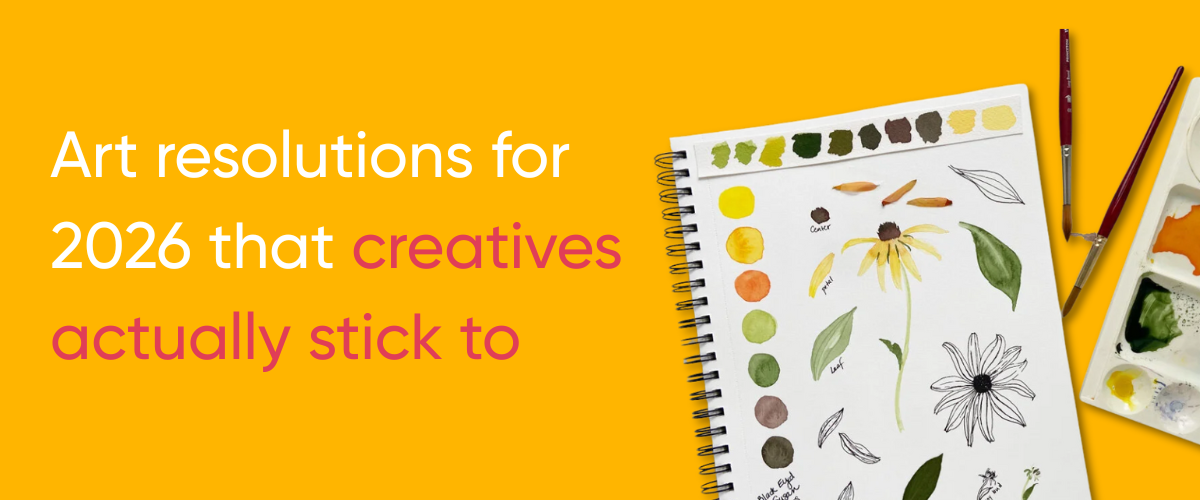
3. Learn Colour Theory (Yes, It’s Scary. Yes, It Helps Enormously.)
Colour theory gets a bad rap for being complicated, but learning the basics actually makes creating feel easier. When you understand how colours work together, you’re not guessing every step or stressing about getting it “wrong.” It gives you confidence to play with shade and tone, and that’s where the fun really starts.
4. Pick One Skill and Invest 30 Minutes a Week
Not every day. Not forever. Just 30 minutes a week.
Choose one skill, value, perspective, anatomy, composition, colour, and give it a regular, protected slot. Focused learning beats scattered effort every time, and small, consistent study sessions compound quickly.
This is how artists actually improve without burning out.
5. Go on Monthly Art Dates
If you want to stay inspired long-term, schedule inspiration like you would anything else.
Once a month, take yourself on an art date. Visit a gallery or exhibition. Browse art books or magazines. Wander a bookstore and study the illustrations. Sit somewhere interesting and observe what’s around you.
These moments remind you why you like art in the first place and keep your creative tank topped up.
6. Find Inspiration Offline (On Purpose)
The internet is great, but it’s also noisy and comparison-heavy.
Try pulling inspiration from books, magazines, nature, architecture, people-watching, or old exhibition catalogues. Offline inspiration is slower, quieter, and often more original. It gives your ideas space to develop instead of being drowned out by trends.
7. Create a Series Instead of One-Off Pieces
Instead of aiming for one perfect piece, try picking a theme and playing with it over a few works. A zine, a sketch series, a small run of canvases, whatever suits you. When you work in a series, there’s no pressure to get it right straight away. Each piece is just another experiment, and that’s where depth naturally builds.
8. Carry an A5 Art Journal Everywhere
Keep a small A5 journal in your bag. Not for finished work. For noticing.
Sketch things that catch your eye. Write down ideas. Jot colour combos. Capture moments. This turns art into something that lives alongside your life, not something that only happens when conditions are perfect.
9. Become Art Pen Pals
Art mail is wildly underrated. Sketches, collages, mini works, half-finished ideas, send them all. Having someone on the other end waiting for your envelope is weirdly motivating and turns art into something ongoing and fun, and who doesn't like receiving personalised little gifts in the mail?
10. Create a “Bad Art” Sketchbook
If perfection is slowing you down, give yourself a sketchbook with one rule.
Nothing in it has to be good.
Use it for messy studies, experiments, half-formed ideas, and things that don’t work. Having a space where quality doesn’t matter makes it easier to try new things and learn faster without overthinking every mark.
11. Create a Story for Your Work
Think about how work is presented in galleries. Titles, wall text, a bit of context.Try doing the same for your own work. Write a backstory, invent a setting, or decide how this piece fits into a bigger world. You can go full fantasy, full sci-fi, or full gallery wall text. It’s a surprisingly fun way to develop ideas without overthinking the painting itself.
12. Develop an Artist Signature
Create a calling card for your art. Choose a colour combo you always return to, a symbol you sneak into pieces, or a signature style of mark-making. Small, repeatable details are often what make work feel cohesive and unmistakably yours and honestly its just a bit of fun to spark your motivation again.
13. Schedule Art Like an Appointment
Motivation is unreliable. Calendars are not.
Block out time for art the same way you would any other commitment. Even 15 minutes counts. Showing up regularly matters more than how long you stay.
14. Make Art Without Sharing It
Not everything needs an audience.
Give yourself permission to create work that no one else sees. This often leads to the most honest, experimental, and satisfying art.
16. Invest in One Upgrade That Makes Art Easier
Not everything. One thing.
Better storage. A sketchbook you actually love opening. Tools that don’t fight you. Environment matters more than discipline. Remove friction and you remove half the battle.
17. Set a “Minimum Viable Art” Rule
On low-energy days, decide in advance what counts.
One line. One colour. One page. Minimums keep habits alive during rough patches and stop all-or-nothing thinking from taking over.
Beginner-Friendly Tools That Help You Restart Without Overthinking
If you’re coming back to art after a break, the biggest mistake is usually trying to do too much at once. More tools, more options, more decisions. What actually helps is the opposite.
A simple setup removes a surprising amount of resistance. One sketchbook you’re not scared to touch. One paint or pastel set that doesn’t ask you to make a hundred choices before you even begin. Storage that keeps things visible instead of buried in drawers.
That’s often enough to get momentum back.
A lot of artists restarting their practice gravitate towards limited or beginner-friendly paint sets, because fewer colours mean less overwhelm and more time actually learning how things work together. Sets like the Mont Marte Watercolour Basics Kit 25pc Beginner Set or an Acrylic Paint Beginner Set with brushes and canvas included give you a clear starting point without locking you into anything too serious. You’re not committing to a style. You’re just picking something up and having a go.
Story-led starter kits can also be a great nudge if you’re feeling stuck. Bundles inspired by artists you already love, like a Van Gogh–inspired oil painting starter kit, give you direction without pressure. You’re not trying to replicate a masterpiece. You’re using it as a jumping-off point.
If pastels are more your thing, a compact Pastels Beginner Essentials Kit with a pad, fixative, and blending tools keeps everything contained. It’s much easier to start when everything you need lives in one place.
For sketching and journaling, smaller, friendlier formats tend to get used more. An A5 visual diary like the Mont Marte Visual Art Diary Spiral Bound A5 is ideal for resets. It fits in your bag, doesn’t feel precious, and invites quick sketches, notes, and messy ideas. If you prefer something a little sturdier, artists often reach for sketchbooks like the Talens Art Creation Sketchbook for drawing or an Art Spectrum Mixed Media Journal when they want the flexibility to experiment across materials.
Storage also plays a bigger role than most people realise. Tools you can see are tools you actually use.Mobile options like the Artfusion Craftwork Mobile Storage Cart are especially handy if you like working across different mediums. A lot of artists keep one or two setups ready to go in the cart, watercolour on one shelf, acrylic or mixed media on another, so when the urge hits, you can just wheel it over and start. When you’re done, everything rolls away just as easily. Easy setup, easy clean-up, and far fewer excuses not to make art., while compact organisers like the Mont Marte Multi-purpose Storage Box, 3 Drawer Pastel Storage Box, or Portacraft Craft Storage Organiser help keep supplies accessible without overwhelming your space. Marker users often swear by dedicated racks, like the Mont Marte Marker Stand, simply because everything stays visible and ready to grab.
Even small additions can help. A Mont Marte Collapsible Brush Washer keeps clean-up simple and contained, and a Brush Box Desk Easel gives you a dedicated place to paint without needing a full studio setup.
The key thing to remember is that you don’t need to buy everything. You don’t need the “perfect” setup. Restarting your art practice might mean adjusting just one thing. A sketchbook you’re not afraid to mess up. Storage that keeps your tools in sight. A starter set that removes guesswork.
.png)
Frequently Asked Questions About Restarting Your Art Practice
How do I restart my art practice after a long break?
Start smaller than you think you need to. One page, one sketch, or five minutes is enough. Momentum comes from action, not motivation, and restarting gently is far more sustainable than trying to do everything at once.
What if I don’t feel inspired to make art anymore?
That’s normal. Inspiration usually shows up after you start, not before. Treat art like a practice rather than a mood and focus on showing up consistently, even when ideas feel flat.
What art supplies do I need to start making art again?
You only need a few basics: one sketchbook or journal, one surface, and one medium you enjoy. Keeping your setup simple makes starting easier and reduces overwhelm.
How often should I practise art as a beginner or returning artist?
Practise as often as feels realistic for your life. One or two short sessions a week is enough to rebuild confidence and consistency. Regular, manageable practice works better than intense bursts.
What are the best art skills to learn as a beginner?
Some of the most helpful beginner art skills include:
understanding light and shadow (value)
basic colour theory
simple perspective
observation and drawing what you see
These skills improve almost every medium and style.
Is colour theory important for beginners?
Yes, but it doesn’t have to be scary. Learning basic colour relationships helps you make more confident choices and reduces guesswork. Even simple colour studies can make a big difference to your work.
What should I practise to improve my drawing skills?
Focus on observation, proportion, and value rather than detail. Simple exercises like gesture drawing, still life sketches, or drawing everyday objects can dramatically improve your drawing over time.
How can I practise art without getting overwhelmed?
Limit your choices. Work with one medium, one sketchbook, and one focus area at a time. Reducing decisions makes it easier to start and stick with your practice.
What’s the best way to practise art when I don’t have much time?
Short, focused sessions work well. Five to fifteen minutes is enough for a sketch, colour study, or journal page. Consistency matters more than duration.
How can I improve at art without formal training?
Self-directed practice, tutorials, books, and regular experimentation are all effective. Picking one skill to work on and revisiting it weekly helps build progress without pressure.
What’s the best art journal for beginners or returning artists?
The best art journal is one you’re not afraid to use. Many beginners prefer mixed media or visual diaries because they handle different materials and remove pressure to keep things perfect.
How do I know what to practise next in my art journey?
Pay attention to what feels confusing or frustrating in your work. That’s usually your next learning opportunity. Improving one small skill at a time leads to steady, lasting progress.
Before you go, here’s the main thing we want you to take with you.
Restarting your art practice in 2026 doesn’t mean reinventing yourself or overhauling your entire setup. You don’t need a perfect routine, a brand new studio, or a sudden burst of discipline. What actually helps is a setup that works for how you live right now, a few realistic goals, and a way back into making that doesn’t feel like a big performance.
Small actions matter more than grand plans. Opening a sketchbook. Tidying one corner of your space. Testing a new colour combo. Starting a series instead of chasing a single finished piece. All of it counts, and all of it builds momentum.
If you’re looking for ideas to keep that momentum going, we’ve got heaps of blogs that break things down into simple, doable steps. From beginner-friendly guides and creative resets to material deep dives and technique explainers, they’re there to help you get unstuck and keep moving without overthinking it.
There’s no rush and no finish line. Just keep making, keep experimenting, and keep showing up in ways that feel manageable. We’ll be here when you need ideas, supplies, or a little push to keep going.
Let curiosity lead and explore art supplies that make starting feel simple.